SpendRule Raises $2M to Help Hospitals Track and Control Spending
Product
Why Healthcare Contracts Fail After They Are Signed
Written by

Joseph Akintolayo
Co-Founder
Date published
Reading time
Share blog

Executive Summary
Every contract negotiation ends the same way: a signature, a press-worthy savings number, and a false sense that the hard work is done. The hard work, making sure the negotiated rate is what actually gets paid, invoice after invoice, for the life of the agreement, starts the day after signature. It’s the task that no staff member at a health system or hospital is assigned to handle.
Sourcing teams are measured on what they negotiate, but nobody is measured on what survives contact with the invoice. That asymmetry is the root of what we call the post-signature enforcement gap, and it costs health systems real money every billing cycle. Industry research puts the loss at 20% or more of negotiated savings,1 and organizations without automated tracking see realized savings land 30% to 60% below what was forecast at signature.3
This article defines the enforcement gap, explains why it is an architecture problem rather than a staffing problem, and lays out what closing it actually requires: continuous, line-item reconciliation of every invoice against the governing contract, before payment is released.
The Signature Is the Starting Line, Not the Finish Line
The celebration at signature is understandable. Negotiating a major purchased services or professional services agreement takes months of benchmarking, stakeholder alignment, and vendor pressure. When the deal closes, the savings number goes into a board deck, and the team moves on to the next category.
But a negotiated rate is not a realized rate. It’s a promise, and promises decay without enforcement. The contract says one thing. The invoices that arrive over the following thirty-six months say whatever the vendor's billing system produces. Unless something or someone actively reconciles the two, the gap between them widens quietly, one line item at a time.
The Enforcement Gap, Defined
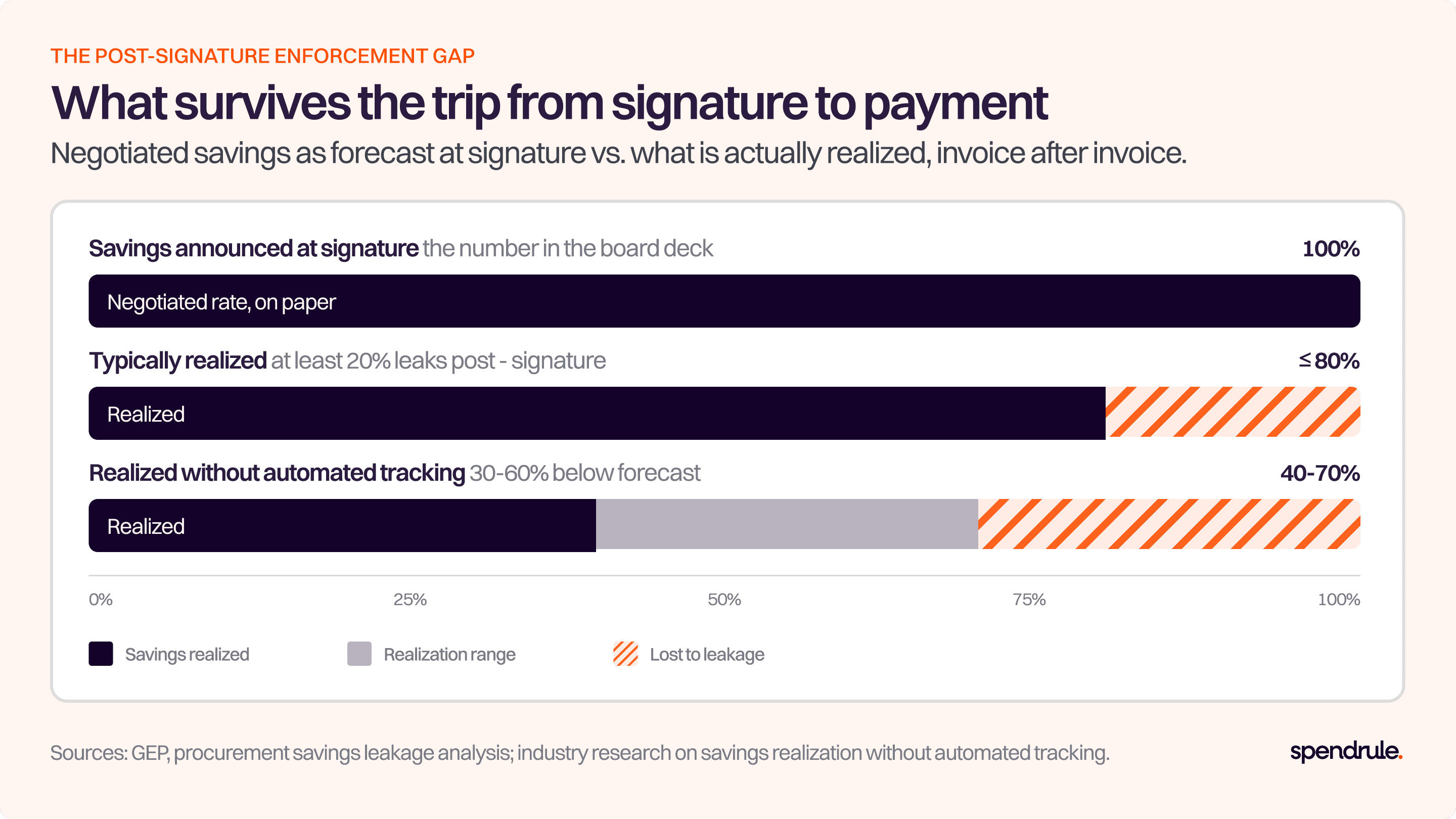
Procurement research consistently finds that organizations lose a meaningful share of negotiated value between contract signature and invoice payment. Analysis from GEP finds that at least 20% of negotiated procurement savings are lost to leakage, and describes savings leakage as a strategic risk rather than an accounting nuisance.1 Efficio Consulting is blunter still: It’s not uncommon for organizations to lose more than half of negotiated savings through lack of compliance alone.2
The gap widens further for organizations flying blind. Research finds that realized, finance-validated savings typically land 30% to 60% below the forecast calculated at signature for organizations without automated tracking in place.3 And when organizations finally look closely, the findings are rarely small. McKinsey research on procurement transformation, cited in the same analysis, describes how invoice-to-contract reconciliation with one company uncovered more than $10 million in value leakage that had gone entirely undetected, the difference between what was negotiated and what was actually paid.3
The leakage doesn’t happen in one dramatic event. It happens in hundreds to thousands of small, structural ways: a vendor price increase that technically requires renegotiation but gets applied automatically because nobody flags it. A service tier that quietly shifts from standard to premium on the invoice without a corresponding amendment. A rebate or volume discount that was contractually earned but never credited, because no one is tracking volume against contract thresholds in real-time. Each individual variance is small enough to clear accounts payable without a second look. Compounded across hundreds of contracts and thousands of invoices, they are a margin problem.
This Is Not a Procurement Failure. It Is an Architecture Failure.
It’s tempting to blame sourcing teams for not following up, but that misreads the problem. Sourcing teams already have a full-time job finding and negotiating the next deal. Expecting the same team to also manually re-verify thousands of recurring invoices against contract terms, month after month, for every active agreement, isn’t a staffing gap, it’s an architecture gap. The contract lives in one system. The invoice lives in another. Nothing connects them at the moment that matters, which is the moment before the payment is released.
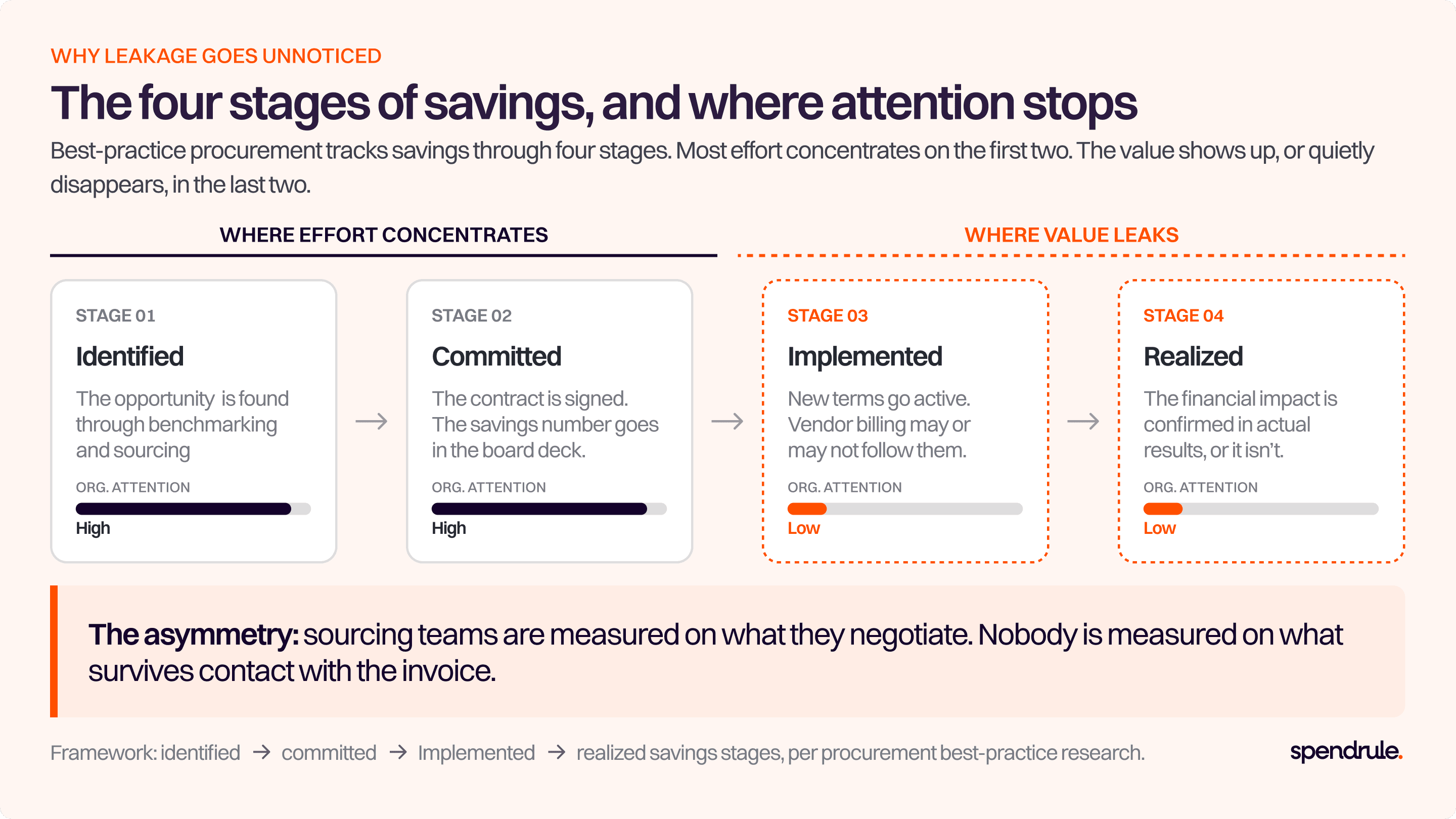
Best-practice procurement organizations describe savings as moving through four distinct stages: identified, when the opportunity is found; committed, when the contract is signed; implemented, when the new terms go active; and realized, when the financial impact is confirmed in actual results.4 Most contract management effort concentrates on the first two stages, finding the opportunity and getting it signed. Far less goes into implemented and realized, which is exactly where the rate negotiated on paper either does or doesn’t appear in bottom line.
That neglect is expensive, because compliance is one of the most controllable levers procurement has. As Arkestro notes, compliance is typically tracked by comparing actual spend against contract terms and approved catalogs.5 It’s measurable, it’s enforceable, and it sits entirely within the organization's control. Yet it’s the lever most organizations pull least often, because no system in the standard stack is responsible for pulling it.
What Enforcement Actually Requires
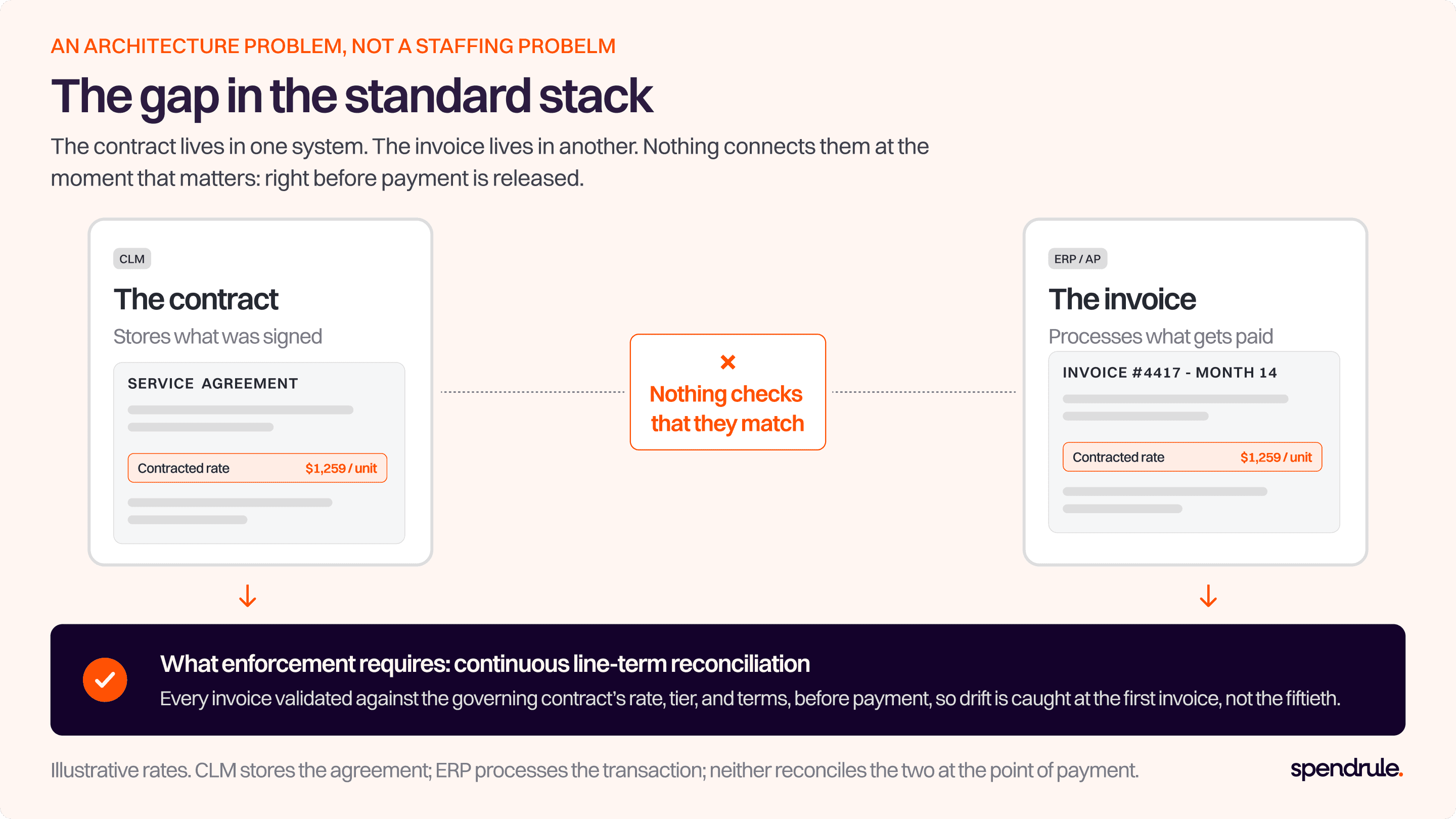
Closing this gap doesn’t require renegotiating contracts more aggressively. The rates already negotiated are, in most cases, perfectly good rates. It requires validating, at the line-item level, that every invoice paid against a contract reflects the rate, tier, and terms that were actually signed, and doing it before payment, not in a review a year later when the variance has already compounded across hundreds of invoices.
That is a fundamentally different capability from what CLM or ERP systems offer today. Those systems were built to store the contract and process the transaction. They were not built to continuously reconcile the two against each other. A CLM can tell you what the contract says. An ERP can tell you what was paid. Neither one is architected to ask, on every invoice, whether those two things match.
Enforcement, done properly, is continuous rather than periodic, automatic rather than manual, and preventive rather than corrective. It treats every invoice as a compliance checkpoint instead of a data-entry task to clear as quickly as possible. And it catches drift at the first invoice, when the fix is a corrected and resubmitted invoice or a single credit memo, rather than at the fiftieth, when it’s a negotiation.
What Supply Chain and Finance Leaders Should Do This Quarter
Pick your five highest-dollar purchased services and professional services contracts and ask a simple question: when was the last time someone checked, line by line, whether the rate on this month's invoice matches the rate in the executed agreements?
If the honest answer is "we trust the vendor to bill correctly" or "we would only know if finance flagged a variance," you have an enforcement gap, and it’s almost certainly bigger than your team assumes. The data suggests a starting estimate: take the savings number announced at signature and assume 20% or more of it is quietly leaking back out, unless you’re actively verifying otherwise.1
At SpendRule, we built our platform specifically to close that gap: continuously matching invoice line items against active contract terms so that drift gets caught at the first invoice, not the fiftieth. The contract-to-payment connection that the standard technology stack never made is the entire product.
Conclusion
Health systems don’t have a negotiation problem. Decades of strategic sourcing, group purchasing, and benchmarking have made contracting teams great at getting favorable terms on paper. What they have is an enforcement problem: no system, no process, and no owner responsible for making sure the favorable terms survive the trip from signature to payment.
The organizations that protect margin over the next decade will be the ones that treat signature as the midpoint of value capture rather than the end of it. The negotiation was never the hard part. Keeping the deal you signed is.
See what contract enforcement can recover for your organization.
Give SpendRule 10 contracts and 10 invoices. We will surface real savings opportunities in under 10 minutes.
Visit spendrule.com/10-10-10
Sources
GEP, The Hidden Leakage in Procurement Savings and How to Fix It. Cited for the finding that at least 20% of negotiated procurement savings are lost to leakage.
Efficio Consulting, What Happened to the Procurement Savings You Promised?. Cited for the finding that organizations commonly lose more than half of negotiated savings through lack of compliance.
Suplari, Procurement Savings Dashboards: What to Track, How to Build, and Mistakes to Avoid. Cited for realized savings landing 30% to 60% below forecast without automated tracking, and for the McKinsey procurement transformation research describing more than $10 million in value leakage uncovered at one pharmaceutical company.
LightSource, Savings Realization. Cited for the four-stage savings framework: identified, committed, implemented, realized.
Arkestro, The CFO's Guide to Measuring Procurement ROI: 8 Key Metrics. Cited for compliance being tracked by comparing actual spend against contract terms and approved catalogs.
Joseph Akintolayo
Co-Founder
Share blog