SpendRule Raises $2M to Help Hospitals Track and Control Spending
Product
The Gap Between AI Pilots and Real Deployment in Healthcare
Written by

Joseph Akintolayo
Co-Founder
Date published
Reading time
Share blog

Healthcare organizations are investing heavily in artificial intelligence. Across the industry, organizations are experimenting with predictive models, automation tools, and generative AI platforms, yet most AI initiatives never progress beyond pilot programs (Harvard Business Review). While the industry has demonstrated strong interest in AI-driven transformation, there remains a significant gap between experimentation and enterprise-wide operational deployment.
Despite the clear potential of AI in the field, healthcare environments are operationally fragmented, highly regulated, and deeply dependent on workflow coordination across clinical, financial, and administrative systems. This reality makes successful AI deployment operationally challenging.
Many healthcare AI projects succeed in controlled demonstrations but struggle when introduced into real operational settings where adoption, integration, governance, and accountability become far more complex.
Our view at SpendRule is that the future of AI in healthcare will be decided by something less visible than the models themselves: an organization's ability to put intelligence to work inside real workflows. AI creates value only once it is embedded in the day-to-day decisions operational teams are already making.
Healthcare AI Stalls Between Pilot and Production
Healthcare systems today are overwhelmed with operational complexity. They operate across disconnected platforms, legacy infrastructure, fragmented procurement processes, and siloed financial systems. Thus, most healthcare organizations are already struggling to coordinate operations before AI is introduced into the environment.
Within this environment, AI implementation becomes significantly more difficult than anticipated, and most healthcare organizations approach AI through isolated pilot initiatives designed to test narrow use cases such as:
Predictive analytics
Supply chain forecasting
Clinical documentation support
Revenue cycle optimization
Procurement automation
Administrative workflow assistance
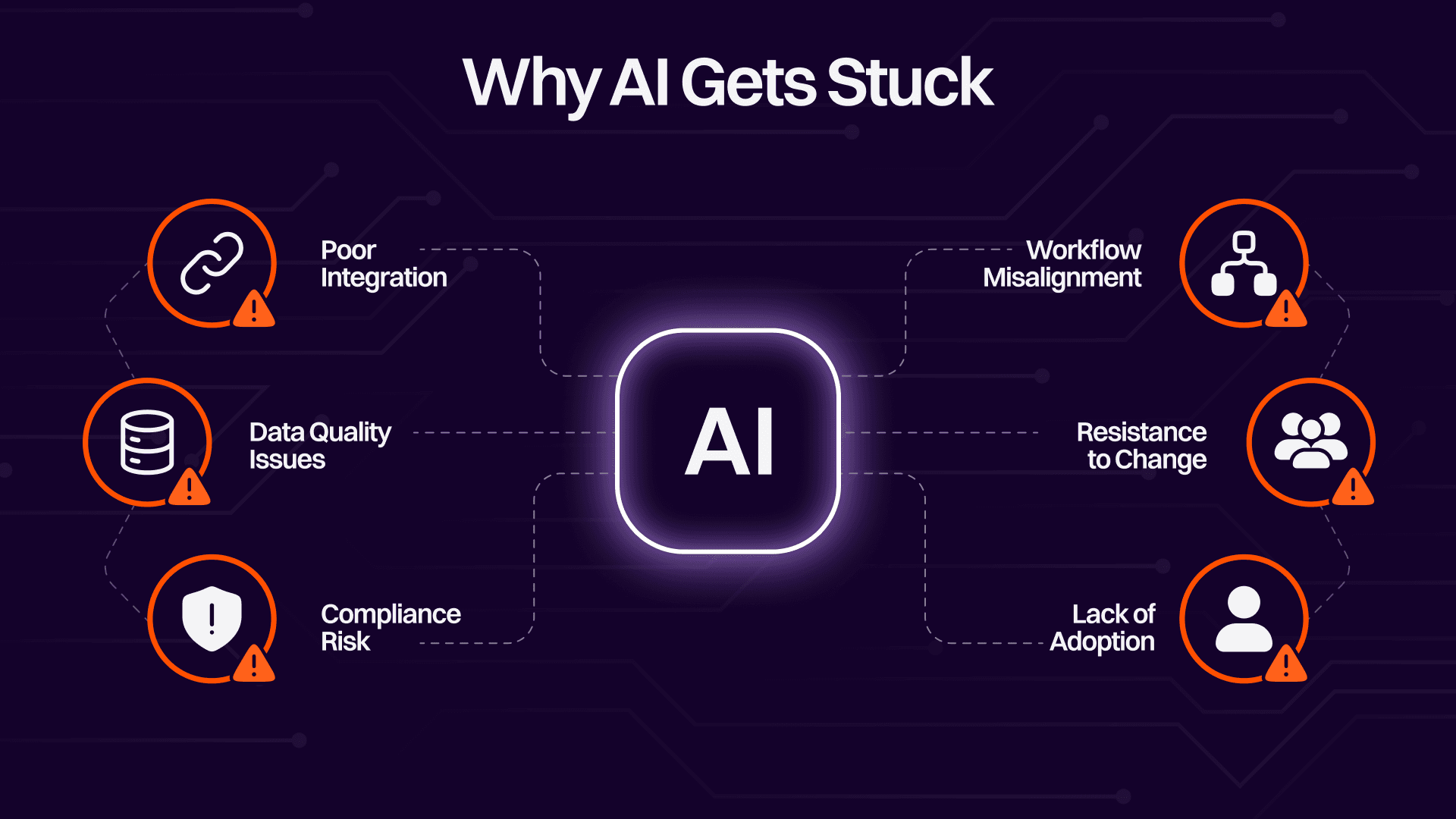
While many pilots produce promising results, organizations often encounter major obstacles when attempting broader deployment (Healthcare IT News). Common barriers include:
Poor integration with existing systems
Limited operational adoption
Inconsistent data quality
Lack of workflow alignment
Regulatory and compliance concerns
Resistance to process change
As a result, many AI initiatives remain trapped in experimentation phases without generating measurable enterprise-wide impact.
How Healthcare Organizations Approach AI Today
Despite the promise of AI, the healthcare industry still treats many AI initiatives as innovation exercises instead of operational transformation efforts (PwC Health Research Institute). The emphasis is often on proving the technology works, not whether the organization is prepared to use it consistently.
This distinction is important. Just because a pilot is successful does not mean an organization is operationally ready for enterprise deployment.
In many cases:
AI systems are introduced without workflow redesign
Frontline teams are excluded from implementation planning
Operational accountability is unclear
Data remains fragmented across departments
Success metrics are poorly defined
The result is a growing disconnect between AI potential and operational reality, with healthcare organizations often underestimating the importance of workflow integration. AI insights alone do not create transformation unless they influence real operational decisions consistently across teams.
The Barrier to AI Adoption: Operational Readiness
The primary barrier to healthcare AI adoption is not the technology itself, but whether the organization is ready to implement and operationalize it at scale.
Healthcare organizations cannot scale AI successfully within fragmented systems that lack coordination, visibility, and process alignment (HIMSS). To be usable, scalable, and valuable, an AI system in healthcare must:
Produce operationally usable data
Connect with existing workflows
Create or follow standardized decision-making processes
Be trusted and adopted
Embed intelligence directly into operations
We built SpendRule on a different premise. AI should function as part of a connected operational framework that sharpens decisions across procurement, finance, and operations, rather than sitting off to the side as a disconnected analytics layer. The organizations that win with AI will not necessarily be the ones with the most advanced models. They will be the ones with the strongest operational foundations.
AI Deployment Inside Healthcare Systems
In practice, healthcare operations remain highly fragmented and reactive. Many organizations still rely on:
Manual procurement workflows
Spreadsheet-driven analysis
Delayed reporting cycles
Email-based approvals
Disconnected operational systems
Introducing AI into these environments without operational alignment often increases complexity rather than reducing it. For example:
A forecasting model may identify an inventory risk, but if procurement approvals still move through email chains and spreadsheet reviews, the insight rarely changes the outcome.
In many organizations, AI recommendations introduce a parallel process rather than improving the existing one. Staff end up working around the system instead of inside it.
If AI systems slow down approvals or add friction to existing workflows, staff may bypass them entirely in favor of manual processes they trust.
When data differs across departments or reporting systems, leadership teams may hesitate to act on AI-generated recommendations with operational or financial consequences.
This creates a situation where AI appears promising during pilot stages but struggles under enterprise-scale operational conditions.
In our model, AI is not a replacement for operational teams but an enabler of smarter coordination, visibility, and execution. The goal was never automation for its own sake. It is operational intelligence that drives faster, better-informed decisions across systems that rarely talk to each other.
What Successful AI Deployment Requires
Organizations that are succeeding with AI are approaching deployment differently. They start with workflows, not models, and focus on integrating intelligence into existing operational decisions rather than creating separate analytics environments (Accenture Healthcare Technology Vision). They also prioritize data interoperability across procurement, finance, inventory, and operational systems. Without that foundation, AI outputs remain difficult to trust and difficult to act on.
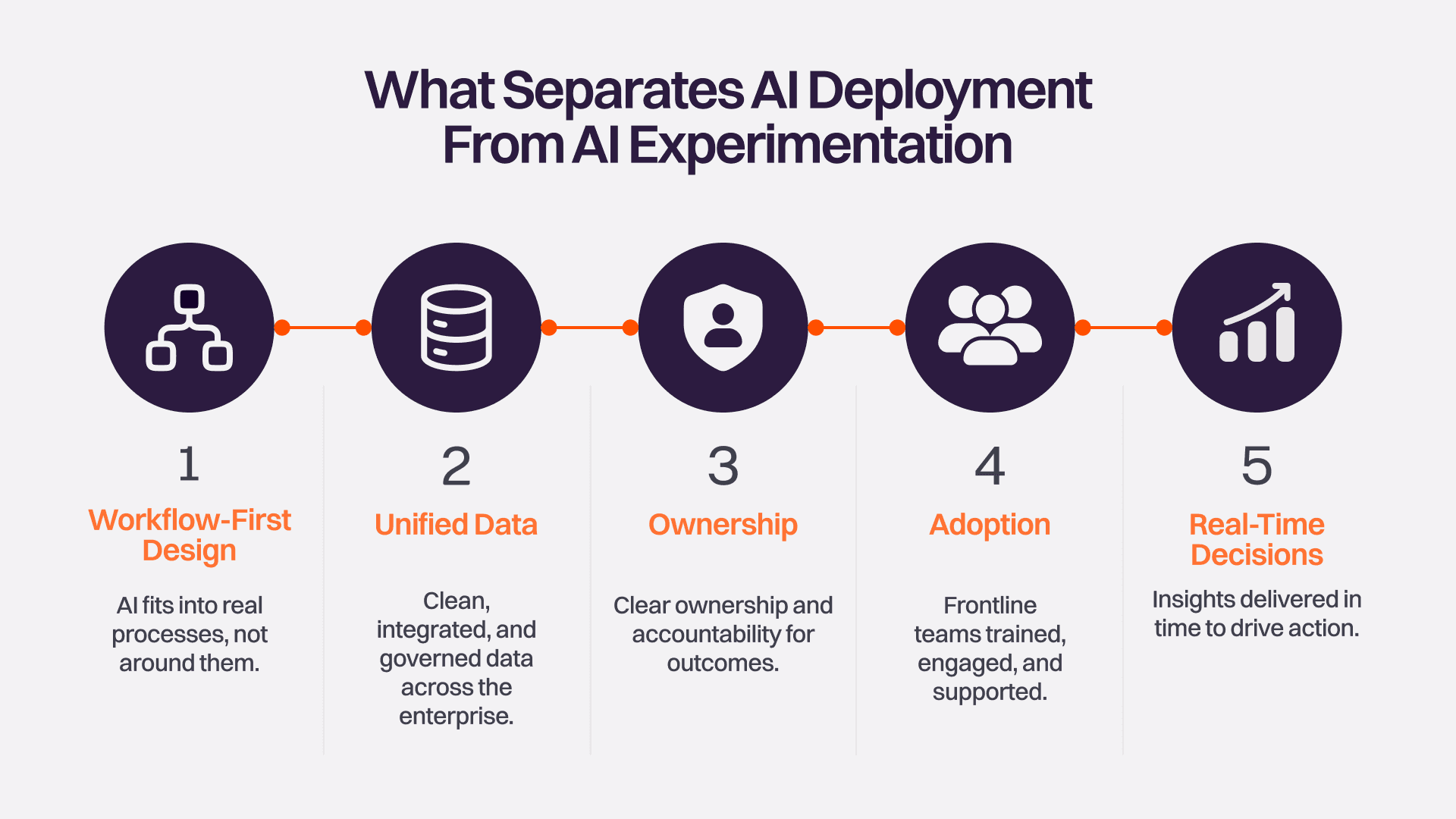
Most importantly, healthcare organizations deploying AI effectively are treating adoption as an operational process, not just a technology rollout. In practice, successful deployments require a consistent set of operational conditions:
Workflow-First AI Deployment. AI should integrate directly into operational workflows instead of functioning as a separate reporting layer.
Unified Operational Data. Organizations must improve interoperability between procurement, finance, inventory, and operational systems.
Clear Operational Ownership. AI initiatives require accountability structures that define how insights translate into action.
Incremental Operational Adoption. Successful deployments prioritize incremental improvements that build trust and usability over time rather than attempting large-scale disruption upfront.
Real-Time Decision Support. AI should support live operational decisions rather than simply producing retrospective analytics.
This is the direction we believe healthcare technology must evolve toward at SpendRule, using intelligent systems to strengthen operational coordination, financial visibility, and enterprise-wide decision-making.
The Real-World Impact of AI Deployment
Healthcare organizations that fail to operationalize AI effectively risk repeating the same pattern of wasted innovation spending, pilot fatigue, and low adoption rates that have defined earlier waves of digital transformation. In these environments, technology ecosystems become increasingly fragmented, and return on investment remains limited despite continued experimentation.
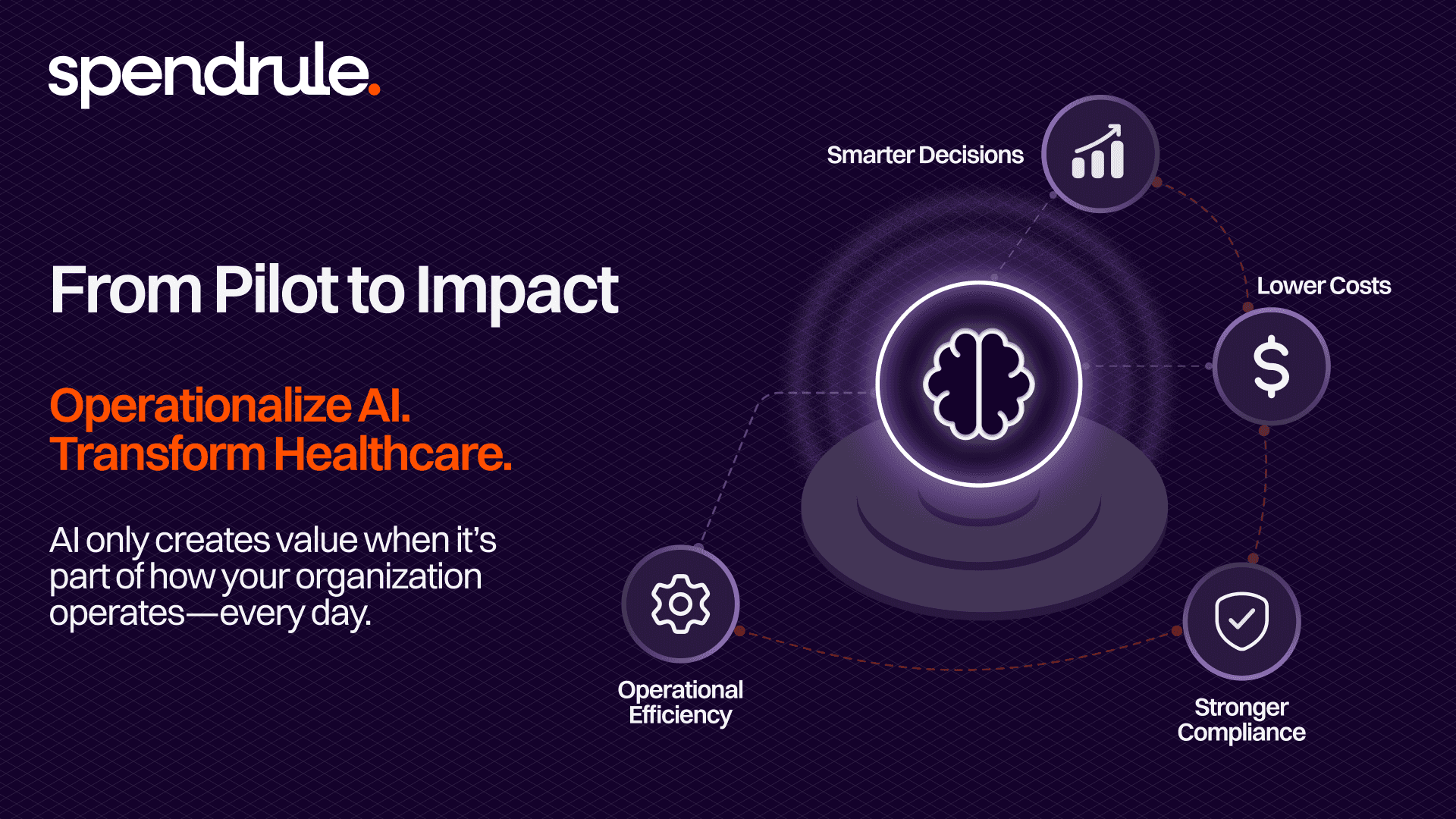
By contrast, organizations that successfully embed AI into operational workflows will begin to see measurable improvements in decision-making speed, procurement efficiency, financial visibility, and overall operational resilience. Over time, this will also strengthen coordination across functions that have traditionally operated in silos.
Execution Will Make the Difference
The healthcare industry is entering a critical phase in its AI transformation journey. Most AI pilots fail because organizations focus on technology capability without addressing operational infrastructure, workflow integration, and organizational readiness.
The next generation of healthcare AI has to move past isolated experimentation toward integrated operational intelligence: systems that support real-time decision-making across the entire enterprise. That is the bet we are making at SpendRule.
The organizations that successfully bridge the gap between AI pilots and operational deployment will shape the future of healthcare efficiency, resilience, and financial sustainability.
Joseph Akintolayo
Co-Founder
Share blog